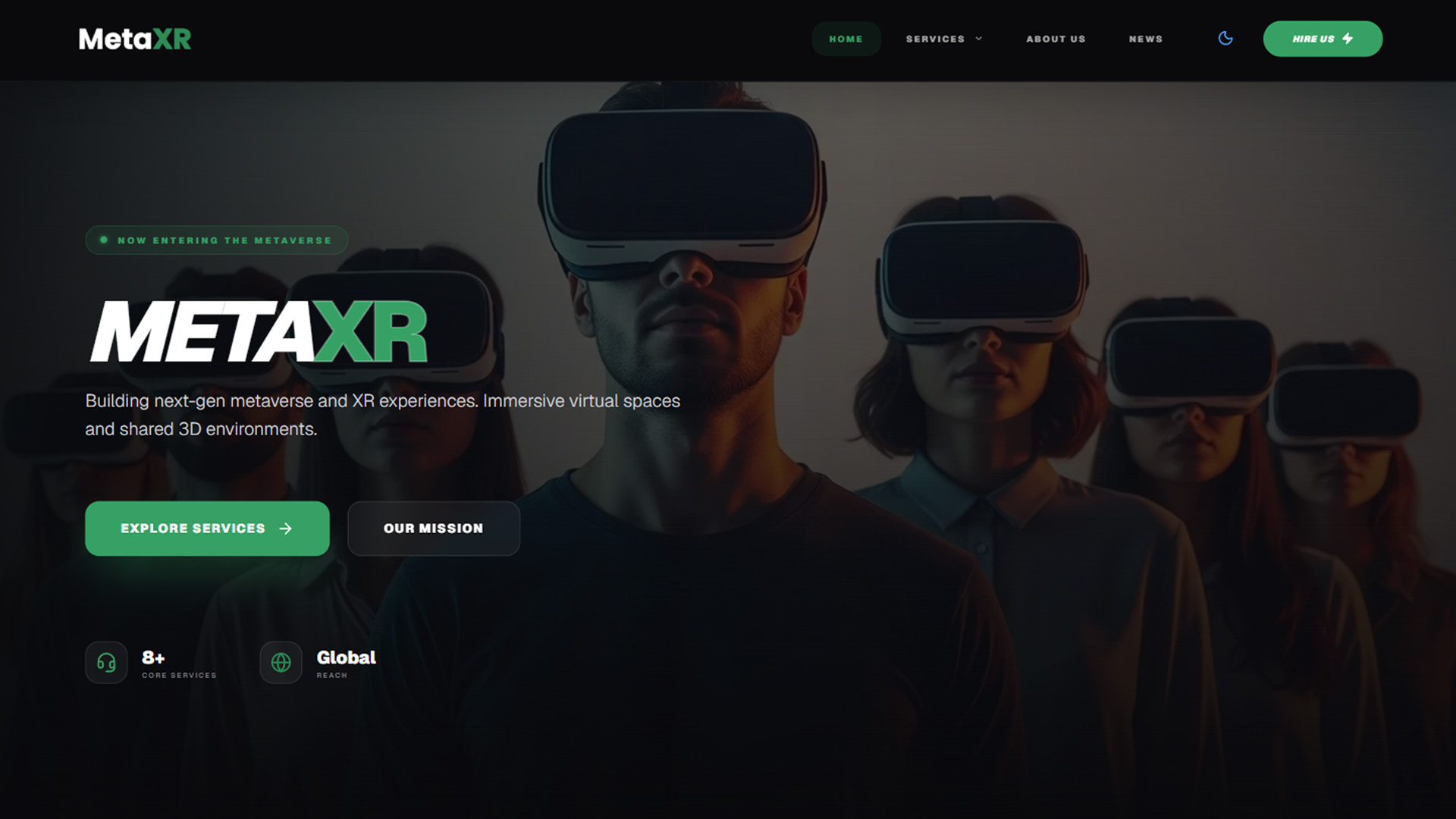
Meta
XR
Created a unified extended reality (XR) platform using Next.js and TypeScript to showcase immersive VR, AR, and mixed reality experiences within a single interactive web environment.
Overview
//The challenge, goals, and constraints.
Challenge
The challenge was to design a unified XR platform that could seamlessly present VR, AR, and mixed reality experiences while maintaining strong performance, responsiveness, and scalability.
Goals
Build a unified XR showcase platform
Combine VR, AR, and MR experiences
Ensure high performance and responsiveness
Develop scalable Next.js architecture
Strengthen XR digital presence
Deliverables
Architecture and stack
//High-fidelity technology blueprint.
Results
//Processing final performance telemetry.
Delivered a unified XR platform that brings together VR, AR, and mixed reality experiences with strong performance, scalability, and a modern interactive interface.
Deep Dive
//Analyzing granular implementation metrics.
Unified XR Experience Layer
Unified XR Experience Layer
- [1]VR showcase sections
- [2]AR demo layouts
- [3]MR experience integration
- [4]Interactive UI components
- [5]Immersive navigation system
Designed to unify all immersive technologies into a single seamless user experience.
Performance Optimized Architecture
Performance Optimized Architecture
- [1]SSR rendering with Next.js
- [2]Static generation for key pages
- [3]Lazy-loaded assets
- [4]Optimized media delivery
- [5]SEO-first structure
Focused on maintaining high performance despite heavy immersive content.
Scalable Component System
Scalable Component System
- [1]Reusable UI components
- [2]Strict TypeScript structure
- [3]Modular architecture
- [4]Dynamic routing system
- [5]Maintainable codebase
Built for long-term expansion across XR categories and experiences.
Transmission
//Initiate system synchronization.
Explore the Future of XR
Discover immersive extended reality experiences combining VR, AR, and mixed reality technologies in a unified platform.